African Burial Grounds Memorial. Photo by Reinhard Dietrich (Own work) [CC0], via Wikimedia CommonsThe African Burial Ground National Monument marks the Lower Manhattan location of a burial ground where enslaved and free Africans were buried during a time period from the 1690s to 1794. The burial ground was located outside the boundaries of the early settlement of New Amsterdam, which later became New York.
The long-forgotten burial ground was found in 1991 when an archaeological survey prior to the construction of the Ted Weiss Federal Building discovered intact burials. Community activists worked to ensure that the area was preserved and protected.
A monument stands on the site today. The monument, designed by Rodney Leon, was designated as a national monument in 2006.
A visitor center on the ground floor of the Ted Weiss Building contains exhibits about the burial grounds and about the role Africans played in the building of early New York City.
An article by Edward Rothstein in the February 25, 2010 edition of the New York Times, provides good background about the monument and the discoveries at the site: A Burial Ground and Its Dead Are Given Life.
Location & Hours of Operation
The African Burial Ground National Monument is in Lower Manhattan, behind the Ted Weiss Federal Building, which is at the intersection of Broadway and Reade Street. The location is a block north of City Hall.
The street address for the Ted Weiss Federal Building is 290 Broadway. The monument is behind the building, at the intersection of Duane Street and Elk Street. The visitor center is in the Ted Weiss Building, on the ground floor.
Admission to both the memorial and visitor center is closed on Sundays and Mondays. The monument and visitor center are open Tuesday through Saturday from 10:00 a.m. to 4:00 p.m..
The memorial closes for the winter (closing November 1 and reopening April 1). The visitor center remains open year around.
Because the visitor center is located in a Federal building, airport-type security screening is in place at the entrance.
Note: The memorial and visitor center and operated by the National Park Service. Hours of operation are established by the Federal Government and subject to change. Please visit the memorial’s website for updates.
Admission to the memorial and visitor center is free.
The Red Cube is an iconic public sculpture piece located in Lower Manhattan at Broadway and Liberty Street.
Although the sculpture is titled “Red Cube” and appears to be a cube, it’s actually not a quite a cube. The shape is stretched out along one axis, adding to the somewhat precarious feeling of the piece’s balance on one point. The bright red color stands out in stark contrast to the blacks and grays of the surrounding skyscrapers. It makes a nice photo op.
The Red Cube is the work of Japanese-American artist Isamu Noguchi. Additional Naguchi pieces can be found at the Noguchi Museum on Long Island.
Location
The Red Cube sculpture is in the Financial District of Lower Manhattan. It’s on Broadway, between Liberty and Cedar Streets, and across from Zuccotti Park.
Nearby sights include The World Trade Center, 9/11 Memorial, Trinity Church, and the Federal Reserve Bank.
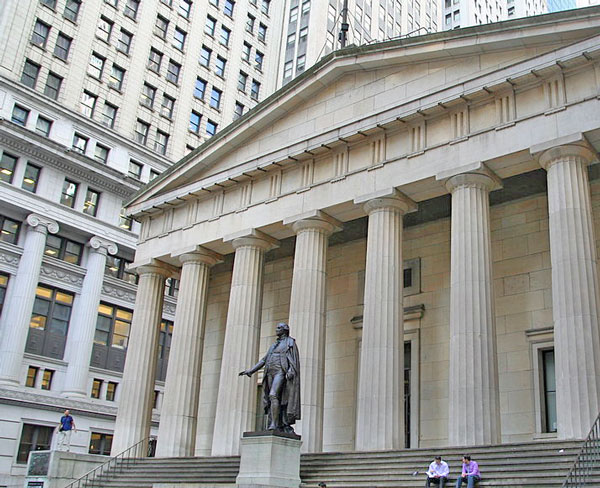
Federal Hall National Memorial. Photo by MusikAnimal (Own work) [CC BY-SA 4.0], via Wikimedia CommonsThe Federal Hall National Memorial marks the site which served as the first capital of the United States and where George Washington was inaugurated as President of the United States.
The monument is open from 9:00 a.m. to 5:00 p.m. Monday – Friday (closed on the weekends).
Admission is free.
This site is closed on Thanksgiving Day and Christmas Day.
History of Federal Hall
George Washington took the oath of office as the first President of the United States at Federal Hall in New York City. That structure served as the nation’s first capitol building and was where the Bill of Rights was introduced to congress. Unfortunately, that original building was demolished in 1812.
A chunk of the original Federal Hall building – a piece of the balcony on which George Washington stood for his first inauguration – was preserved and is on display in the National Memorial.
The structure which now operates at the Federal Hall National Memorial was constructed on the same site as the original Federal Hall. It was originally constructed as the United States Customs House for the Port of New York in 1842. It served as the Customs House until 1862, then as a United States Sub-Treasury location, before being established as the Federal Hall Memorial National Historic Site in 1939.
A bronze statue of George Washington has stood on the steps of the structure since 1883, marking the approximate location where he stood when first inaugurated as President of the United States.[spacer height=”20px”]
Exhibits
The monument’s galleries feature exhibits about George Washington and the early days of the United States of America. Items on display include the bible used when George Washington took his oath of office as President.
The monument’s visitor center is located near the Pine Street entrance, on the main floor. You’ll find a park ranger there to answer questions, plus the center is operated in cooperation with NYC’s tourism organization, so there’s lots of information about other New York City attractions.[spacer height=”20px”]
Location
The Federal Hall National Memorial is located on Wall Street in the Financial District of Lower Manhattan.
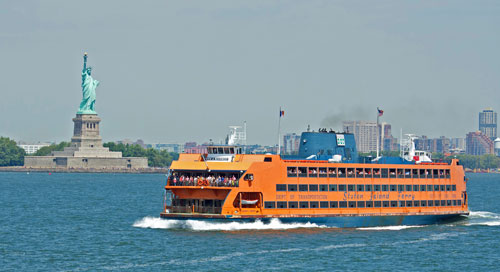
The Staten Island Ferry carries commuters from Staten Island to Manhattan, but it also carries tourists who want to see the view of the city and the Statue of Liberty. The ferry is free and departs about every half hour, depending on the time of day.
The trip between Staten Island and Manhattan takes about 25 minutes each way. Along the way, you’ll have nice views of the Statue of Liberty and the skylines of New Jersey, Staten Island, Brooklyn, and Lower Manhattan.
Concessions on the ferry sell food and beverages, including beer.
Scheduling and other information provided here is accurate to the best of our knowledge at time of publication. Please visit the ferry’s website to confirm details.
Schedule
The ferry runs around the clock most days of the year. Departures are about every 15 minutes during week day rush hours and every 30 minutes to an hour the rest of the time. Evening hours provide some great opportunities to view the illuminated Statue of Liberty and the lights of the Manhattan skyline.
Bad weather and reduced visibility may cause schedule changes.
On specific holidays (New Year’s Day, President’s Birthday, Memorial Day, Independence Day, Labor Day, Thanksgiving Day and Christmas Day) the ferry operates from 7:00 a.m. to 11:00 p.m. on a 30 minute schedule.
Street View. Drag mouse or use arrows and compass to scroll.
The ferry runs between Whitehall Terminal in Manhattan and St. George Terminal in Staten Island
The Whitehall Terminal is located at 4 South Street in Lower Manhattan, near Battery Park.
Things to Do in Staten Island
Many people just ride the ferry for the view and then turn around and ride right back. If you can spare the time, though, there are some interesting things to see in Staten Island.
Note: To make the round trip, you’ll need to disembark on one side and enter back trough the terminal building for the return trip.
The St. George Esplanade provides great views of Manhattan and is where you’ll find Staten Island’s 9/11 Memorial. The Staten Island Museum is a great place for families to visit, and WPA murals in the Borough Hall provide an interesting look at Staten Island history.
During the summertime, you can attend a Staten Island Yankees minor league baseball game. The ball park is within easy walking distance of the ferry terminal.
Castle Clinton National Monument in Battery Park[spacer height=”20px”]
Castle Clinton. Photo by Muncharelli (Own work) [CC BY-SA 4.0], via Wikimedia CommonsCastle Clinton, also known as Fort Clinton, is located in Lower Manhattan at Battery Park. It has had many uses over the years. Originally used by the US Army as a fort, it was later used as an entertainment center, then served as the county’s first facility for processing immigrants, from 1855 to 1890. The site is now operated by the National Parks Service.
Castle Clinton is open to the public and admission is free.
Free ranger-guided tours are available Monday – Sunday at 10:00 a.m, Noon, 2:00 p.m., and 4:00 p.m.. The tours last about 20 minutes.
Castle Clinton is where you purchase tickets for the Statue of Liberty ferry. If you’re making the trip out to the Statue of Liberty, allow a little time before or after to look around the castle and view the exhibits on display.
If you’re exploring Lower Manhattan, the free Downtown Connection shuttle bus provides service to Battery Park and other sites, including the World Trade Center and South Street Seaport.
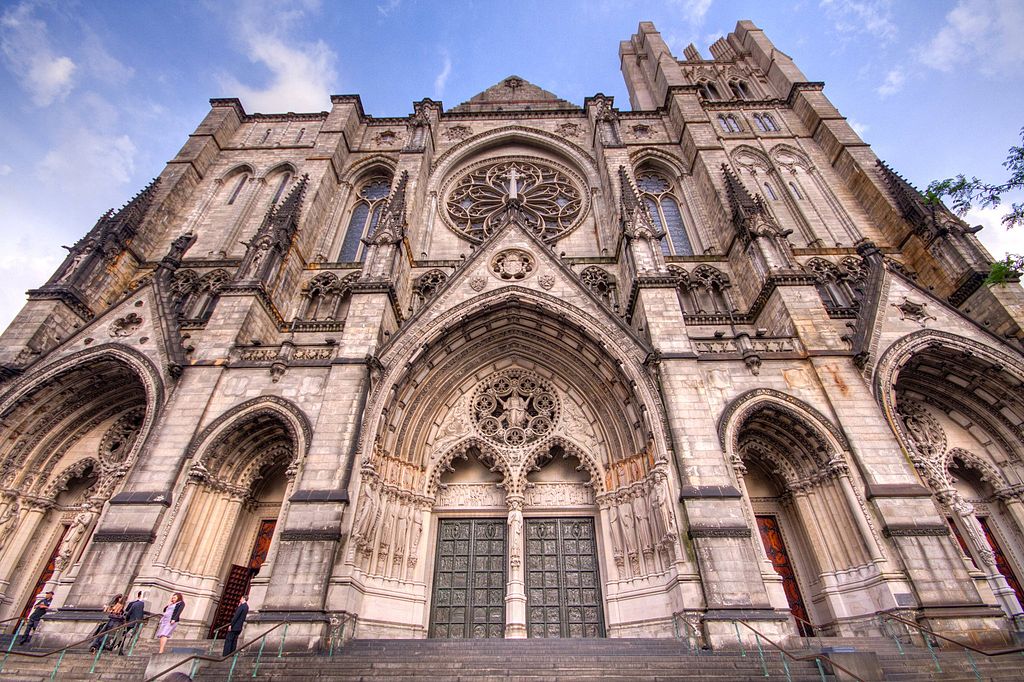
Cathedral of St. John the Divine. Photo by Kripaks (Own work) [CC BY-SA 3.0], via Wikimedia CommonsEnjoy a midday break with The Cathedral Church of Saint John the Divine’s Midday Monday organ performances.
Each Monday at 1:00 p.m., a Cathedral organist performs a 30-minute demonstration of the Cathedral’s Great Organ.
These short performances give visitors an opportunity to hear the Cathedral’s spectacular organ while enjoying the architecture of the massive Gothic cathedral. Be sure to allow yourself time to tour the Cathedral while you’re there.
The Cathedral actually has five organs, with the Great Organ being the largest. The Great Organ was built in 1911 and expanded on it 1954 by renowned organ-builders Earnest M. Skinner and G. Donald Harrison. The organ has over 8,000 pipes and includes the famous “state trumpet stop”, one of the most powerful (and loud) organ stops in the world.
The Cathedral Church of St. John the Divine
The Cathedral Church of St. John the Divine is the Cathedral of the Episcopal Diocese of New York. It is chartered as a house of prayer for all people and a unifying center of intellectual light and leadership.
Construction of the Cathedral began in 1828 and although the structure has been fully functional and in use since the 1940s, construction and renovation are ongoing.
The Cathedral, which is the largest in the world, is built in the High Gothic architectural style. The entrance is marked by 18-foot high bronze doors fabricated by the same Paris firm that cast the Statue of Liberty. Fourteen themed bays in the Nave honor professions and human endeavors such as communications, medicine, law, and sport, A centerpiece of the structure is the 40-foot in diameter Great Rose Window, which is the largest in the United States.
The Cathedral grounds include over 11 acres of gardens and greens. You’ll find a biblical garden, with plants mentioned in scripture; and the 40-foot high Peace Fountain; the Pulpit Green here. The grounds are also the home to several resident peacocks.
Brochures for self-guided tours of the Cathedral can be acquired from the Cathedral’s Visitor Center, or downloaded in advance. Guided tours are also available for a fee.
Location and Hours of Operation
The address for the Cathedral is 1047 Amsterdam Avenue. It is located in the Morningside Heights neighborhood of Manhattan, at the intersection of Amsterdam Avenue and 112th Street.
The Cathedral grounds (known as The Close) are open to the public during daylight hours. Entrances are located on Amsterdam Avenue at 110th and 11th Streets.
The Cathedral is open from 7:30 a.m. to 6:00 p.m., with limited access on Sundays. Full access on Sundays available between 1:00 p.m. and 3:00 p.m..
The visitor center is open from 8:00 a.m. to 6:00 p.m. daily.
Theodore Roosevelt Birthplace National Historic Site
Theodore Roosevelt Birthplace in Manhattan. Photo by Beyond My Ken (Own work) [GFDL or CC BY-SA 4.0-3.0-2.5-2.0-1.0], via Wikimedia CommonsTheodore Roosevelt, the 26th President of the United States, was born in a New York City brownstone in 1858 and lived there until he was 14 years old.
Although the house located is on the site where Roosevelt was born, the structure is actually a reconstruction. The home where Teddy Roosevelt was born was originally constructed in 1848, torn down in 1916, and then reconstructed by the Women’s Roosevelt Memorial Association on the same site after Roosevelt’s death in 1919. Many of the furnishings on display are from the original Roosevelt residence. Today, the house is owned, maintained, and operated by the National Park Service.
The historic site includes the home and a small museum section with a display of Roosevelt artifacts. An interpretive guide provides tours of the residence. Tours depart on the hour.
Theodore Roosevelt Birthplace NHS is open Tuesday-Saturday, 9:00 a.m.- 5:00 p.m. The site is closed on the following designated federal holidays: Thanksgiving Day and Christmas Day.
Admission is free of charge.
Location
The Theodore Roosevelt Birthplace address is 28 East 20th Street, between Broadway and Park Avenue.
The “Love” Sculpture in NYC. Photo by Hu Totya (Own work) [Public domain], via Wikimedia Commons
Love
The Love sculpture in Manhattan provides a great NYC photo opportunity. The statue is located at the intersection of 6th Avenue and West 55th Street (map).
Pay a visit to this iconic piece of street art if you’re in the neighborhood .It’s located in Midtown Manhattan, about halfway between Rockefeller Center and the southern entrance to Central Park. There’s also a nice fountain across the street that’s in the form of a dandelion seed head.
“Love” was created by American artists Robert Indiana. The design was actually created for a Museum of Modern Art Christmas card in 1964.
NYC’s “Love” sculpture is one of many that now appear around the world. The first sculpture was created by the artist for display at the Indianapolis Museum of Art in 1970. Since then, versions of the statue have been placed in dozens of locations world-wide.
Hope
A similar “Hope” statue was installed at the corner of 7th Avenue and 53rd Street in 2014. It’s located just a block off of Broadway, near the Theater District.
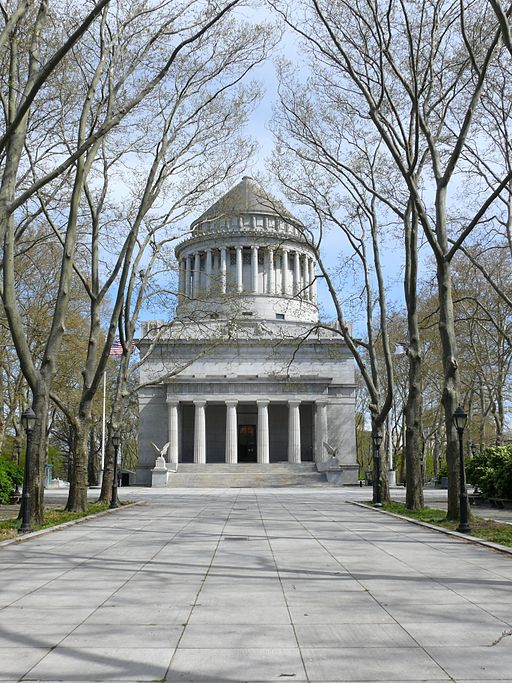
Grant’s Tomb. Photo by Ad Meskens (Own work) [CC BY-SA 3.0 or GFDL], via Wikimedia CommonsUlysses S. Grant, Civil War general and 18th U.S. President, died in 1885 at the age of 63. He was living in Mount McGregor, New York at the time.
Grant’s family chose New York City as his final resting place, in part, because that was where Mrs. Grant intended to reside, and she wanted her husband’s monument nearby. When she passed away in 1902, she was laid to rest in Grant’s Tomb, by her husband’s side
After several years of fighting between Washington DC and New York City over which city the monument to Grant should be located in and several more years designing, funding, and constructing the monument, Grant’s Tomb was completed in 1897, twelve years after General Grant’s death. Read more about the history of Grant’s Tomb at Wikipedia.
Grant’s Tomb is the largest mausoleum in North America. The monument is constructed of granite and has a domed rotunda which overlooks a crypt with matching red granite sarcophagi where President and Mrs. Grant are entombed.
A visitors center is located near the tomb. The visitor center has exhibits and a short film about General Grant, a bookstore, and public restrooms.
The official name of the monument is the General Grant National Memorial. The monument has been managed by the National Park Service since 1958.
Visiting Grant’s Tomb
Grant’s Tomb is located in Riverside Park in the Morningside Heights neighborhood of upper Manhattan. The entrance to the memorial is near the intersection of West 122nd Street and Riverside Drive. See a map.
Grant’s Tomb is open to the public from 10:00 a.m. to 11:00 a.m., 12:00 p.m. to 1:00 p.m., 2:00 p.m. to 3:00 p.m., 4:00 p.m. to 5:00 p.m. Wednesday through Sunday. The visitors center is open from 9:00 a.m. to 5:00 p.m. Wednesday through Sunday.
There is no admission fee charged to visit Grant’s Tomb or the visitor center.
You may have heard the question, “Who’s buried in Grant’s Tomb?” The answer would be Grant, right? Well, not exactly. The tricky part is the use of the word “buried” in the question. The correct answer is “no one,” since Grant and his wife are entombed in sarcophagi above ground in an atrium rather than being buried in the ground.
The question originated with Groucho Marx’s 1950s TV show “You Bet Your Life”.
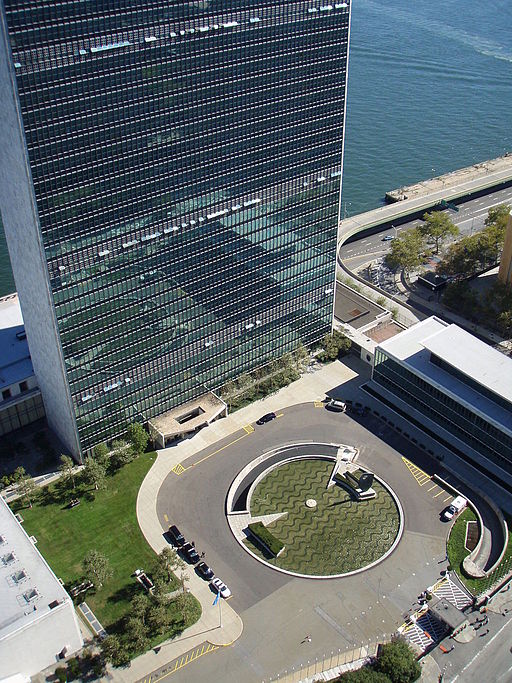
The United Nations Headquarters on the East River. Photo by English: Foreign and Commonwealth Office (Flickr) [OGL], via Wikimedia CommonsThe United Nations Visitors’ Lobby and Visitor Centre are open to the public and there is no admission fee. If you want to see areas of the headquarters beyond the lobby and Visitor Centre, you’ll need to take a guided tour, for which there is a fee (see details below).
The U.N. Headquarters is located in the Turrle Bay neighborhood of Manhattan, on the East River. The address is 760 United Nations Plaza (see map).
The visitors’ entrance is located at 46th Street and 1st Avenue. However, before entering there, visitors must acquire a U.N. Security Pass from the Visitors Check-in Office at 801 First Avenue (corner of 1st Avenue and 45th Street). Everyone 18 years or older must show a government-issued photo ID in order to receive a pass. Visit the U.N. security page to see a list of items that you’re not allowed to bring into the U.N. Headquarters.
There are exhibits available for viewing by the general public in the Visitors’ Lobby. See information on current exhibits at the U.N. Exhibits website.
By visiting the United Nations building, you’ll do a little international travelling without ever leaving New York City. The United Nations Headquarters is actually an international territory that belongs to the member states of the United Nations.
Guided U.N. Tours
Guided tours of the United Nations Headquarters are available for a fee ($22 for adults, $15 for students, seniors, and children). Note that children under the age of five are not permitted on the tour. You can book your spot on a tour online in advance, or a limited number of same-day tour tickets may be available on-site.
On the tour, you’ll learn about the work of the United Nations and United Nations Organizations. If official meetings are not in session, you’ll be able to see the General Assembly Hall, the Security Council Chamber, the Trusteeship Council Chamber, and the Economic and Social Council Chamber. You’ll also see the 30 articles of the Universal Declaration of Human Rights displayed on panels by Brazilian artist Octavio Roth, artifacts from the nuclear explosions in Nagasaki and Hiroshima, and works of art donated to the United Nations by member states. More information.
The Visitor Centre is located in the basement of the General Assembly Building and is where you’ll find the U.N. Post Office, U.N. Bookshop, U.N. Gift Shop and counters for UNICEF, WFUNA, Women’s Guild, and UNESCO. All are free to visit and open to the public.
U.N. Shops
There are several shops located within the UN Visitor Centre.
The U.N. Bookshop carries a variety of international publications for children and adults, plus posters, music, postcards, toys, and U.N. logo gifts and souvenirs.
The U.N. Gift Centre sells a variety of things from UN member countries. You’ll find traditional handmade items as well as U.N. and NYC souvenirs at the Gift Centre. Several other U.N. organizations have counters in the visitors center at which you’ll find information and items for sale.
U.N. Post Office
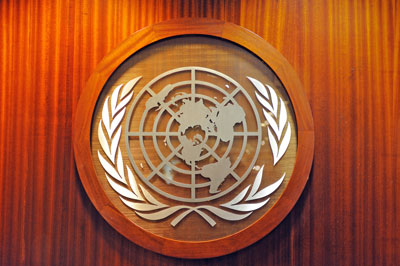
United Nations Seal
The U.N. operates it’s own post office and issues special U.N. stamps to be used in mailing items from within the headquarters. To commemorate your visit to this unique space, you can purchase a special card and U.N. stamp at the gift shop and mail it from the official U.N. post office.
The Visitor Centre Cafe
There is a cafe in the Visitor Centre that serves up a variety of international food, including sushi, paninis, hers, and baguette sandwiches.
The Delegates Dining Room
It takes a little pre-planning to dining in the Delegates Dining Room, but if you plan ahead and make your reservations ahead of time, you could find yourself enjoying lunch alongside ambassadors and international dignitaries.
The catch is that the Dining Room does not accept walk-ins. You must make a reservation as least one day in advance. Also, there is a business dress code for visitors dining in the Delegates Dining Room. Jackets are required for the men. No jeans, shorts, sneakers, or flip-flops allowed. Visit the Delegates Dining Room reservations website for details.
Lunch is a 3 course meal with a menu changes with the seasons. Price is $39.99, excluding beverages, gratuities, and tax.
To get an idea of what dining in the Delegates Dining Room is like, read a Wall Street Journal reporter’s account of her experience there: Wining and Dining Like a U.N. Delegate
Hours and Admission
The Visitors’ Lobby and Visitor Centre are open Monday through Friday from 9:00 a.m. to 4:30 p.m. and on Saturdays & Sundays from 10:00 a.m. to 4:30 p.m. (there are no weekend hours in January and February). The headquarters and Visitor Centre are closed on major holidays. Please visit the UN Headquarters website to see a list of closure dates and to confirm hours of operation.
There is no admission fee to visit the U.N. Headquarters Visitors Lobby or Visitors Centre.







.jpg)